Sunday Sermon, 15 February 2026
Next Before Lent, Cornerstone Community Church, Sedbergh
You can read the sermon below, or listen here:
A reading from St Paul’s First Letter to the Corinthians
And so, brothers and sisters, I could not speak to you as spiritual people, but rather as people of the flesh, as infants in Christ. I fed you with milk, not solid food, for you were not ready for solid food. Even now you are still not ready, for you are still of the flesh. For as long as there is jealousy and quarrelling among you, are you not of the flesh, and behaving according to human inclinations? For when one says, ‘I belong to Paul’, and another, ‘I belong to Apollos’, are you not merely human?
What then is Apollos? What is Paul? Servants through whom you came to believe, as the Lord assigned to each. I planted, Apollos watered, but God gave the growth. So neither the one who plants nor the one who waters is anything, but only God who gives the growth. The one who plants and the one who waters have a common purpose, and each will receive wages according to the labour of each. For we are God’s servants, working together; you are God’s field, God’s building.
According to the grace of God given to me, like a skilled master builder I laid a foundation, and someone else is building on it. Each builder must choose with care how to build on it. For no one can lay any foundation other than the one that has been laid; that foundation is Jesus Christ. Now if anyone builds on the foundation with gold, silver, precious stones, wood, hay, straw— the work of each builder will become visible, for the Day will disclose it, because it will be revealed with fire, and the fire will test what sort of work each has done. If what has been built on the foundation survives, the builder will receive a reward. If the work is burned, the builder will suffer loss; the builder will be saved, but only as through fire.
Do you not know that you are God’s temple and that God’s Spirit dwells in you? If anyone destroys God’s temple, God will destroy that person. For God’s temple is holy, and you are that temple.
Do not deceive yourselves. If you think that you are wise in this age, you should become fools so that you may become wise. For the wisdom of this world is foolishness with God. For it is written,
‘He catches the wise in their craftiness’,
and again,
‘The Lord knows the thoughts of the wise,
that they are futile.’
So let no one boast about human leaders. For all things are yours, whether Paul or Apollos or Cephas or the world or life or death or the present or the future—all belong to you, and you belong to Christ, and Christ belongs to God..
1 Corinthians 3 NRSV
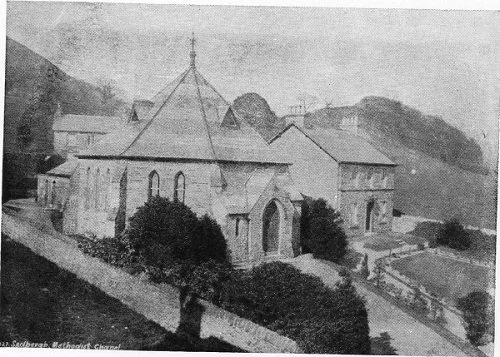
Sedbergh Methodist Chapel, built in 1865
The Methodist church in Sedbergh was established over 200 years ago, in 1805, under the influence of the preaching of Jonathan Kershaw. The original chapel was situated just down the road, where New Street meets Main Street. Half a century later, the old chapel had grown too small for the congregation, so a new octagonal building was built where we are worshipping this morning, in 1865, at a cost of £1,000. (Show photo). It would be fascinating to go back in history and experience worship in this smaller setting. I suspect it would have felt more intimate, with less hierarchy than a traditional church building. Half a century later, the chapel was again found to be too small, so it was enlarged in 1914 to its present size, at a cost of £2,100. Since then, it has been looked after by each subsequent generation, and just a few years ago the inside of the chapel was modernised and refurbished.
What is the purpose of this chapel? It exists in order to facilitate worship: a sacred space for the church to gather, as we receive from God in sacrament and word. And, given it is a Methodist chapel, it was assumed that this would involve a lot of gusty and wholehearted singing!
But apart from the names of a few noteworthy preachers, we do not remember those who oversaw the building of the original chapel in 1805, and the new chapel in 1865. They were hugely important in completing the work and making sure that it was done safely and to the right specifications. But they didn’t design this chapel for their own glory; the purpose of the building is to facilitate worship, and its builders and renovators faded into the background when their work was done. When we gather to worship in this space, our thoughts are directed not towards them, but towards the God that they were serving.
* * *
In our passage from 1 Corinthians, St Paul is telling the young church that they are viewing things in completely the wrong way. They are ‘topsy turvy’ in their thinking, because they are elevating their church leaders above the church congregation. Some follow Apollos, some follow Paul, some follow Peter. It’s as though they’re thinking of their church leaders as being like football managers, who lead opposing teams that they each have to support. But Paul wants them to invert their thinking. They’ve got things the wrong way round. It is the church congregation that is of primary importance; the leaders are simply there to serve the church. Let these words of Paul sink in: “let no one boast about human leaders. For all things are yours, whether Paul or Apollos or Cephas or the world or life or death or the present or the future—all belong to you, and you belong to Christ, and Christ belongs to God” (1 Corinthians 3:21-23 NRSV).
“All things are yours” – the church does not belong to its leaders, but rather its leaders belong to the church.
To illustrate this he uses two metaphors. I borrowed one of them for the opening illustration to this talk – the church is like a building, or a temple, to the Lord – and its leaders are simply the construction workers. Their role is certainly important, but it is not remembered. It is simply in service of the building, which belongs to the Lord. Rather than being like opposing football managers, church leaders are more like successive project managers, who (in theory) are all working towards the same goal.
The other metaphor that Paul uses to describe the church is that of a field. Paul plants, Apollos waters, but only God gives the growth. Again, it shows that the primacy is not with human leaders, but with God’s initiative as he establishes the church. I’m not very experienced at gardening, but I know enough to know that an arrogant gardener doesn’t get very far. Gardeners need to be attentive to the land and to the plants, and work with the seasons and nature if they are to be successful. So also, Christian leadership ought to have a good dose of humility and dependence upon God.
So the Corinthians are viewing things ‘upside down’. Human leaders are not there to be venerated or played off against one another; they are there to serve, and to work together for the good of the church: after all, the church is God’s field, God’s building, God’s temple.
* * *
There are two applications I would like to draw from Paul’s teaching this morning. The first is to emphasise the value of the local church. Paul has a high view of the church, and it shows why he was so concerned about the divisions and dissensions that were appearing amongst the Corinthians. He didn’t want the precious work of God that had begun in Corinth to collapse into ruin and decay.
In contrast to this, we now live in an age which has devalued the church. I was reading an article this week about Gordon Brown, one of our former Prime Ministers. As the son of a Kirk minister, his politics are deeply informed by Christian social values. I am impressed by his consistency and his principles. But one part of the story stood out to me – that although he still believes in God, he is not a regular churchgoer. There are many who are in the same position – people who might believe in God, or at least claim its Christian values, but who choose not to attend a local church congregation.
At one level, this is understandable. After all, there are more divisions in the church today than in Paul’s Corinthian congregation – and I daresay worse behaviour. And let’s be honest, we can be an awkward group of people when we want to be. We shouldn’t dismiss those who have looked at the state the church is in today, and simply say: ‘no thanks’.
And yet, to devalue the church is to miss its hidden glory, according to St Paul. The church is God’s temple. It is here, as we gather to worship and to minister to one another in this place, that the Holy Spirit makes Christ known in a special way in the world. Of course, God is not limited by the church; he reveals himself in many places and in many ways. But it is the church that has been charged with making Christ known, through the preaching of the forgiveness of sins, and the sharing of the special meal which announces peace to the world, and to which all are invited.
The church possesses a ‘hidden glory,’ which is revealed not in human power or magnificence, but in weakness and brokenness. It is grounded in the work of God, in his forgiveness, reconciliation, and power.
I have been privileged to see this hidden glory in many ways over the years, as I am sure you have as well. I think of the good souls who have offered encouragement and kindness over the years. Those who have made sacrifices for others at great personal cost. Those who have opened their homes and their hearts with laughter and friendship. Those whose lives are a testament to the generous grace of God. Those who have persevered with quiet faithfulness and humility. Many of the folk I have been impressed with in the church are not very conventional – I sometimes think that we in the church are all a little bit mad – but there is a wonderful ‘holy foolishness’ that is tucked away in God’s church.
Of course it can also be a ‘hidden glory’ because so often the church forgets the message of the cross, and the weakness that this entails, and starts boasting in its accomplishments and its legacy in a triumphalist manner. But St Augustine adds to St Paul’s metaphors when he describes the church as a hospital – a place where saints and sinners congregate for healing and encouragement. We are God’s field, God’s building, God’s temple, and God’s hospital – and may this encourage us to keep going, and persevering with one another, as we meet together in Christ’s name. The church is precious, and St Paul wants us to remember that.
* * *
The second application I would like to draw out of this morning’s reading regards the leadership and direction of the church.
I began this sermon with the illustration of the building of this chapel, and how this was inspired by St Paul’s metaphor for the building of the church. Well, at certain points in its history, as with all church buildings, this building needed to be adapted and changed in order to serve its purpose as a place of worship. And each time, it required new builders to complete the work.
Similarly, the church requires leaders who will be able to build upon the work that has gone before, and help the church to remain steady and robust for the new situations it faces. This is serious work. St Paul says that these builders will be tested; if their work stands, they will be rewarded, but if not they will be saved as though through fire. These verses speak of the coming judgement, and the fact that all those charged with the care of the church will need to give an account of their works before God.
It is an interesting question who Paul is referring to in these verses. Paul and Peter were apostles, but Apollos was a fellow missionary. At its broadest, we could interpret Paul as suggesting all those who minister in the church will have to give an account – and at some level, we are all ministers one to another in a church setting. However, it seems clear that the focus is particularly upon those charged with positions of authority in the church, which in our various denominations are sometimes called presbyters, priests, deacons, bishops, and overseers.
This of course includes myself, and I want you to know that I take these verses very seriously.
We are going through a time of change and transition, as our culture rapidly transforms, and as our churches must adapt to our new circumstances. I am aware that we need to think carefully about the future, and make decisions for the good of the local church, the living stones of the Western Dales. Later in the year, on 16th May, we are holding a special Vision Day, when we can come together and think about what sort of spiritual building work needs to be done in this place, and all of the practical challenges that accompany that spiritual work. I ask for your prayers and participation as together we discern a good way forward in the Western Dales.
But above all, I am mindful of St Paul’s conviction that here in the local church, we share a common foundation with the global church, and with the historic church: “For no one can lay any foundation other than the one that has been laid; that foundation is Jesus Christ” (1 Corinthians 3:11 NRSV).
I give thanks for our visible unity at these joint services, that we are a sign of God’s work of healing and reconciliation. But none of us know what the future holds. Sometimes it feels like we are stumbling through in the night, in weakness, and with faltering steps. But if we remember that our foundation is Jesus Christ and him crucified, I believe God will equip us for what lies ahead. After all, Christ is the foundation that cannot be shaken – the Cornerstone – and it is in our weakness that God’s love, grace, and power will shine through. May we continue to hold to this, as together we build upon the solid ground of Christ’s love.
In his name, Amen.