Sunday Sermon, 8 February 2026
2 Before Lent, St Andrew’s Church, Sedbergh
You can read the sermon below, or listen here:
A reading from St Paul’s First Letter to the Corinthians
When I came to you, brothers and sisters, I did not come proclaiming the mystery of God to you in lofty words or wisdom. For I decided to know nothing among you except Jesus Christ, and him crucified. And I came to you in weakness and in fear and in much trembling. My speech and my proclamation were not with plausible words of wisdom, but with a demonstration of the Spirit and of power, so that your faith might rest not on human wisdom but on the power of God.
Yet among the mature we do speak wisdom, though it is not a wisdom of this age or of the rulers of this age, who are doomed to perish. But we speak God’s wisdom, secret and hidden, which God decreed before the ages for our glory. None of the rulers of this age understood this; for if they had, they would not have crucified the Lord of glory.
But, as it is written,
“What no eye has seen, nor ear heard,
nor the human heart conceived,
what God has prepared for those who love him”—
these things God has revealed to us through the Spirit; for the Spirit searches everything, even the depths of God. For what human being knows what is truly human except the human spirit that is within? So also no one comprehends what is truly God’s except the Spirit of God. Now we have received not the spirit of the world, but the Spirit that is from God, so that we may understand the gifts bestowed on us by God. And we speak of these things in words not taught by human wisdom but taught by the Spirit, interpreting spiritual things to those who are spiritual.
Those who are unspiritual do not receive the gifts of God’s Spirit, for they are foolishness to them, and they are unable to understand them because they are spiritually discerned. Those who are spiritual discern all things, and they are themselves subject to no one else’s scrutiny.
“For who has known the mind of the Lord
so as to instruct him?”
But we have the mind of Christ.
1 Corinthians 2:1-16 NRSV
We are very used in our culture to seeing images of Jesus. In the western tradition, he is usually portrayed as a handsome, attractive person, clothed in white, with long flowing locks, whose eyes are full of compassion and care. The best of these portrayals reveal a deep respect and reverence for Christ, and can aid us in our devotion. However, they can also veer into sentimentality. They can make Jesus conform to a stereotypical beauty, a sort of inoffensive shallowness that blends into the background. And at their worst, they can exclude those that don’t look much like the western Jesus.
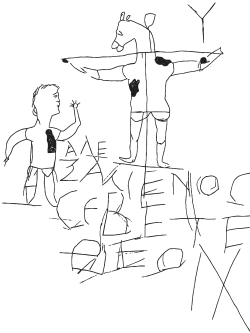
It is a shock to contrast these kinds of images with the very earliest drawing that we have of Jesus. It dates to around 200 years after his birth, and was discovered in the nineteenth century in a room near the Palatine Hill in Rome. It is a piece of graffiti, scratched into the plaster of the wall. It is a crude work, depicting Jesus with the head of a donkey, as he hangs pathetically on the cross. To the left of the cross is a young man, looking up at the grotesque donkey-man. Underneath is inscribed: “Alexamenos worships his God”. It is the work of someone who seems to be jeering and making fun of an early follower of Jesus.
Two images of Christ. One, a figure of beauty. The other, a figure of shame. Which is a truer likeness, and which speaks more of the heart of the gospel?
* * *
In our reading this morning, St Paul reminds the Corinthians of the manner in which he first preached the gospel to them. He came in weakness, with much fear and trembling. He knew nothing among them except Jesus Christ and him crucified. He spoke not with words of human wisdom, but with demonstrations of the Spirit and of power. He came not in his own strength, but in God’s.
It was important that Paul came amongst them in this way, because it mirrors the ‘mystery’ that he had to share with them. In the ancient world, a mystery is a truth, teaching, or decision, made in the heavenly court of God. It is something that was previously hidden, but has now been revealed. The mystery that Paul brought them is this: the Son of God has come among us, not as a handsome and powerful high-born ruler, but as a nobody, who was shamefully crucified like a slave or a common thief.
This is a most shocking truth to discover, because it’s the opposite of what we would expect. In Christ, God came not in power, but in weakness.
Paul knew that the medium must match the message. As he says earlier in the letter, if he had spoken with words of eloquent human wisdom, he would have emptied the cross of its power.
In a similar way, the crudely drawn graffiti, which depicts Jesus as half man, half donkey, hanging upon the cross, is a truer depiction of the Gospel than a perfectly formed and beautiful painting of the saviour. It reflects the mystery of the cross – that God has chosen to be amongst us as one who was ridiculed. The glory of God is hidden in the suffering and muck of the world. Whoever was making fun of young Alexamenos, and his faith in Christ, was inadvertently revealing the mysterious power of the cross.
* * *
According to St Paul, this mystery of God disrupts our usual way of seeing, and allows us to view the whole of existence in a new light. It gives us spiritual sight, which is the gift of God, and cannot be engineered by humans. It enables us to see the hidden glory in things that we previously viewed as worthless.
This is very different from what Paul cauls ‘human wisdom’. From a young age, we learn to see the world through privilege, power, and hierarchy. It’s drummed into us. I remember when growing up, it always felt so important who you got to sit next to in class, or who you got to play with in the schoolyard.
Things don’t change much as we grow older! We seek honour and glory for ourselves in all sorts of ways, whether at school, in the workplace, or in our social lives. We notice the powerful and influential, and overlook those who cannot offer any social advancement. We fill our lives with possessions, experiences, and achievements that help us to feel good about ourselves and hide our weaknesses and insecurities. We always know where we are in the pecking order. As the songwriter Paul Simon sings, ‘One man’s ceiling is another man’s floor’.
But the cross challenges this way of seeing. As we meditate on the cross, God grants us spiritual sight. Our vision is transformed. We see that God has revealed himself in weakness, and in this weakness lies the salvation of the world. We see the power of God, and the new life of the resurrection, hidden in the death of Christ.
This is central to the teaching of Jesus, who saw things as they truly are. He saw that the first are last, and the last are first. He saw that those who are truly great are those who serve others. He saw honour in humility, value in vulnerability, and the humanity of the outcast. He saw the presence of God in the things that are overlooked and treated with contempt.
Rather than shy away from those who were suffering, he looked upon them with compassion. He brought the hidden presence of God into their trials and tribulations, as he suffered alongside weeping humanity on the cross.
As we look upon the cross, we are invited to learn from him, and his way of seeing. By the grace of God, through faith, bit by bit, we begin to see hidden glory in the small and overlooked parts of our world.
* * *
St Paul writes that we are ‘being saved’. Salvation means to be made whole, perfect, to be healed. But this is a gradual process, and none of us are there yet. As we grow as Christians, we have the opportunity to continually develop our spiritual sight, and see the world anew.
I think that is why Paul takes the time and care to write to the Corinthian church that he loves so much. He knows that they are flawed and human. They are divided, arrogant and proud, and this is working itself out in all sorts of destructive patterns of behaviour.
But he also knows that they are in the process of being saved. They have encountered the mystery of God in the cross, and they need to be reminded to return to it, and to learn to see according to its logic, its wisdom, and its power. They need to see through Christ’s eyes, and to share his mind and common purpose.
The same is true for us, wherever we are. Let us ask God for the gift of spiritual sight, that as we are being saved, so we may become those who see things through Christ’s eyes, and that we might have the courage to live according to what we see.
In Christ’s name,
Amen.